Management Roundtable, Inc.

Resources for Innovators

For More Information
Email: info@managementroundtable.com
  • NEWS & INSIGHTS
  • EXPERTS
  • TOPICS
  • PRODUCTS & SERVICES
    • VIRTUAL WORKSHOPS
  • ABOUT
    • PRIVACY POLICY

April 15, 2018 By alexjcooper

Selling Risky Projects to Risk Averse Organizations

Led by Dr. Jay Paap. Leadership wants new innovation but not its inherent risks. Learn how to overcome this roadblock by focusing on impact rather than unknowns.

Password: XRT1
Filed Under: Experts Tagged With: JayPaap

December 23, 2017 By alexjcooper

Smart Products of the Future – Game Changers and Differentiators

Smart Products of the Future – Game Changers and Differentiators

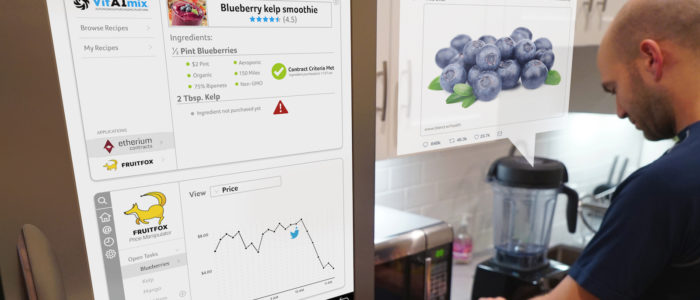
In this age of Alexa, self-driving cars, and Google Home, it’s clear that smart products are here to stay. But what’s coming down the pike may surprise you. Imagine ten years from now when your intelligent “VitAImix” not only guides your recipes and grocery purchases, but influences the price of certain ingredients for everyone!

Rebecca Chesney, Research Director, Institute for the Future (IFTF), explains in Three Strategies for Designing Kitchens of the Future: “As machine intelligence becomes an easily embedded utility service, connected objects are becoming capable of more sophisticated interactions.

Amazon, Alexa, and Google Home are now answering open-ended questions about ingredient conversions and calories for home cooks. Smart ovens are becoming intelligently engineered to automatically recognize what’s in them and how to cook according to individual preferences. In the near term, we can expect to see a proliferation of kitchen technologies embedded with what Kevin Kelly, founding executive editor of Wired magazine, describes as ‘cheap, reliable, industrial-grade digital smartness running behind everything, and almost invisible except when it blinks off.’

These intelligent machines will become networked together and act in concert. Advances across the technology stack will reveal a world in which inanimate objects speak to us, bots act on our behalf, and networked machines negotiate with each other. The Institute for the Future (IFTF) calls this distributed global network of autonomous robots and intelligent systems the Internet of Actions. A kitchen in this world will be more than connected and more than smart—it will be a kitchen of actions.”

She illustrates how a VitAImix in 2027 can learn a family’s food criteria and then tweet, negotiate, and cause prices on a desired but pricey item to drop! While the example is fictitious, the potential impact is very real. The implications for product innovation are profound and far-reaching, going well beyond the kitchen.

Quinault Childs, Rebecca’s colleague, discussed this and other future innovations at the recent Innovation & Growth Leadership Summit.  For a copy of IFTF’s report Food Innovation: Recipes for the Next Decade, contact Jackie Cooper jackie@roundtable.com.
Filed Under: General

December 17, 2017 By alexjcooper

Ask the Agile Stage-Gate Expert: What is the role of process manager?

The third big question posed to Dr. Robert Cooper in our ‘Ask the Agile Stage-Gate Expert’ series is about roles of team members in Agile (versus traditional) stage-gate. Here is what he says:
 
Dr. Cooper: There is a fair amount of controversy and some disagreement among manufacturers regarding the ‘roles’ of people in the new Agile-Stage-Gate system. Some of the confusion comes from the fact that most manufacturers end up using a ‘blended’ system – most of their projects still use the traditional or classic gating process, and a smaller proportion – say 20% of projects (often the riskier or more ambiguous projects) – use Agile-Stage-Gate. Thus they argue that the roles should stay the same as today, because one cannot have two sets of roles in development — a real mess. Of course, in the software world, this is not an issue, as all the code-writing projects in a software firm typically would be done using Agile, not a blended process.
 
Bottom line, recognizing there are differences of opinion among firms, for manufacturers:
 
— the process manager’s job stays much the same as today, except now s/he is overseeing two different types of projects – traditionally-gated projects and Agile-Stage-Gate projects. So it’s a bit more complex. But they still coach the teams, facilitate the gate meetings, keep the database, produce portfolio charts, provide training, etc.
 
— the project leader – most manufacturers have kept this role (but some have opted for the ‘product owner’ role instead. Product owner = a member of management, not on the project team, who meets with the team regularly and provides direction; in this system, there is no team leader per se on the project team!)
 
— scrum master – a new role, on the product team, a “servant” of the team. Ensures that the team works well, and follows the Agile practices (daily scrums, sprint planning, demos, retros, etc.). Some scrum masters serve 2 teams out of necessity.
 
–– project team – for manufacturers, still a cross functional team (Technical, Marketing, Operations, Sales), but in theory 100% dedicated to the one project. Quite different than Agile in the software world, where the ‘team’ is a room full of ‘techies’ or software writers. Most manufacturers break this ‘100% dedicated’ rule for good reason, it’s not practical for them – some assign certain days to the Agile project, for example. While it is not always possible to dedicate a full time team, it is important to have a defined approach of some kind versus leaving it to chance. Resource management is a tough issue and the ‘elephant in the room’ for many companies trying to do Agile-Stage-Gate. Getting the right resources can make or break your efforts.
 ***************
For further insight: Dr. Cooper’s latest book, featuring Agile-Stage-Gate, Adaptive & Accelerated New-Product Development, may be ordered here. He also offers both public and inhouse workshops. For more information, call 781-891-8080 or email info@roundtable.com.

Filed Under: Agile Development Tagged With: Agile, RobertCooper

  • « Previous Page
  • 1
  • 2
  • 3
  • 4
  • 5
  • Next Page »

Latest News and Insights

  • Decisions, Decisions: Which products to develop? What resources to invest? 3 key steps to strategic roadmapping
  • How You Can Take Advantage of Machine Learning to Enhance Your Product AND Process
  • Ask the Stage-Gate Expert – Dr. Cooper Answers Your Top Questions
  • Selling Risky Projects to Risk Averse Organizations
  • Smart Products of the Future – Game Changers and Differentiators

Copyright © 2026 · Management Roundtable, Inc. All Rights Reserved